Views
Alarm Management Software Benefits: 4 Steps to Unlock Them
AUGUST 2025
Many organizations invest in Alarm management software to meet compliance needs or generate monthly reports, but that’s just scratching the surface. When used proactively, this software can reduce operator workload, consolidate alarm data across systems, and minimize costly downtime.
Alarm management software has the potential to improve plant performance every day, not just at audit time.
Yet in my conversations with plant personnel, it’s clear that many still underutilize their systems. They’re missing key opportunities to improve operations, reduce stress, and boost productivity.
This article outlines four simple ways to make your alarm management software work for you, not the other way around.
Many users simply aren’t getting the value they should be from their alarm management software, and this means that many companies are missing opportunities to improve their outcomes.

The best approach to alarm management and the one employed by best-in-class users is to make it part of your day, every day. It doesn’t have to be onerous – in fact, by bringing alarm management into the daily routine, you can make your software work much harder for you.
By using your alarm management software to identify and resolve alarm-related issues quickly, your operators’ working environment will improve, and they will be less stressed, and less likely to make potentially costly mistakes.
Your operators will also be able to move from a reactive approach where they spend their time responding to and servicing alarms, to a more proactive approach where they can monitor and adjust the process to improve operations.
This means fewer process interruptions and potentially, fewer regulatory breaches. Needless to say, the plant will also be more productive, and therefore more profitable too.
4 Steps to Unlock the Benefits of Alarm Management Software
-
Step 1: Understand What Your Alarm Management Software Can Really Do
This may sound obvious but understanding the capability of your software is a quick route to extracting value from it.
For example, a good alarm management software suite will have reporting capabilities built in, such as is the case with ProcessVue Analyser. A tool like this makes it possible to automate and email out a customised daily report of alarms. -
Step 2: Make Alarm Management Software Part of Daily Discussions
Often, morning meetings focus on production targets, losses and challenges, product/grade changes and maintenance issues. But you should also be discussing alarms.
By adding alarm issues to your daily agenda and keeping them there, you will gain better control, reduce the stress of managing alarms and reduce the likelihood of alarm-related issues and avoidable failures.
It goes without saying that unresolved alarm management issues, or important alarms that are missed because they were masked by nuisance alarms, are likely to take up a lot more time in morning meetings if they result in downtime, so the daily time investment is thoroughly worthwhile.
At the very least, review frequently occurring alarms – say the top 10, top 5, or any alarm with more than 500 activations in 24hrs? Choose the criteria, set up the automated reporting, and relax, knowing that nothing is going to sneak up on you. -
Step 3: Track Alarm Issues and Resolutions with Your Team
As the primary alarm system users, your operators are the main beneficiaries of any alarm improvement initiative and are fundamental to its success. Without your operators’ positive engagement in the process, your alarm management journey is likely to falter.
Tracking actions and resolutions is incredibly important. I have lost count of the number of operators I’ve spoken to who say they’ve reported alarm issues on multiple occasions, but nobody listens, and nothing gets done.
If you routinely review, track, and resolve alarm problems, operators are much more likely and confident to speak up and issues can be nipped in the bud or avoided altogether.
The reporting is also an opportunity to set your alarm management approach on a positive footing – teams can take pride in making improvements and productivity KPIs can be boosted. -
Step 4: Identify and Fix High-Frequency Alarm Problems Fast
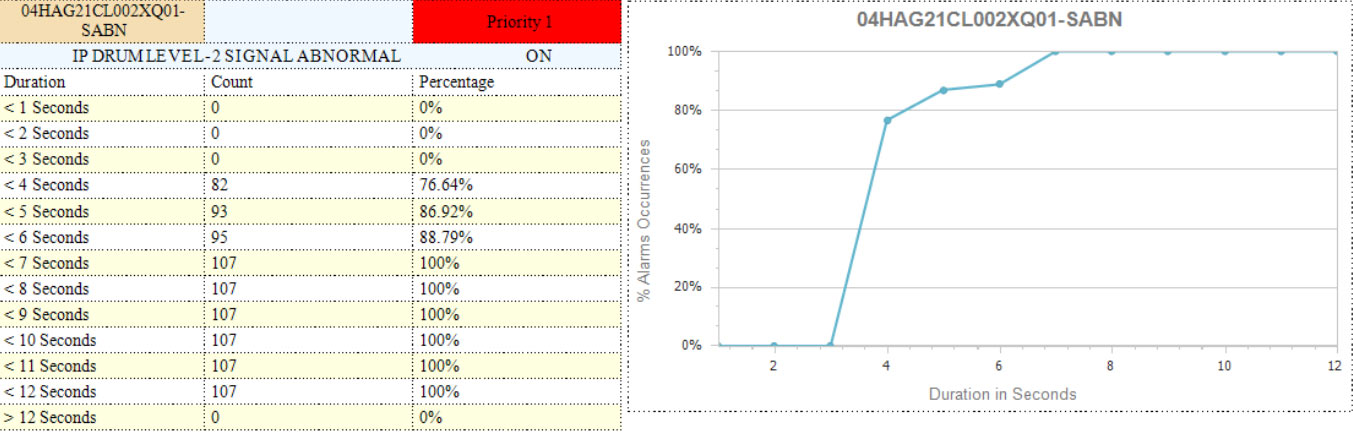
Identify quick wins in your most frequent alarms and deal with them - your operators will thank you. ProcessVue Analyser includes a tool as standard to help identify quick wins, which gives a graphical and tabular indication of alarm activation times.
For context, ISA-18.2 reckons an alarm flood starts once an operator is getting more than 10 alarms in 10 minutes, and says a system should spend less than about 1% of its time in that state, under 15 minutes a day. Every nuisance alarm like the one above is eating into that margin, which is exactly why I'd rather you catch it now than wait for an audit to point it out.
In the example below, the table and chart show that 100% of all activations of this Priority 1 alarm are less than 7 seconds in duration.
Whilst this may be a genuine alarm condition if it persists, short duration activations which may, for example, be caused by waves or ripples on the liquid surface, don’t give an operator enough time to respond appropriately to the alarm, so could a 10-second timer be added to mitigate this nuisance?
Finding and resolving issues like this is easy when your software is designed to help you.
It is not difficult or onerous to make alarm management a part of the daily routine and the benefits of unlocking the value of alarm management software are significant.
Importantly, if you are not using your alarm management software to make sure it serves you, you’ll quickly realise that it is you who are serving your alarm management software – being inundated with alarms, investigating failures, and reacting to avoidable downtime.
Take Control of Your Alarm Management Software, Don’t Let It Control You
If you feel that your alarm management software is bossing you, rather than the other way around, get in touch, or try the four steps above and let me know how you get on.
Once you’ve got these daily habits in place, our Alarm Rationalization service and ProcessVue Guardian can help you take it further.
Grounded in Recognised Standards
None of this is just my opinion, either. These four steps line up with what ISA-18.2 (2016 edition), EEMUA 191 (4th Edition, 2024) and IEC 62682:2023 all recognise as good practice for alarm systems, so if you want the fuller picture beyond these daily habits, our Alarm Management Standards & Guidelines hub walks through what each one covers.
FAQ: Alarm Management Software
Q1: What is Alarm Management Software?
A: Alarm Management Software is a tool used in industrial environments to monitor, analyze, and manage alarms from various systems. It helps operators prioritize alerts, reduce alarm fatigue, and improve overall plant efficiency.
Q2: What are the main benefits of alarm management software?
A: Use it daily, not just for monthly reporting. Integrate it into team meetings, track recurring issues, and act on alarm data insights to drive proactive improvements.
Q3: Why is it important to resolve nuisance alarms quickly?
A: Nuisance alarms can overwhelm operators, cause delays, and hide critical alerts. Addressing them quickly reduces stress, downtime, and risk.
Q4: What features should I look for in a good Alarm Management Software?
A: Look for automated reporting, alarm frequency analysis, integration capabilities, and tools to filter and group alarms by type, duration, and priority.
Q5: Is Alarm Management Software only for compliance?
A: No, while it helps with compliance, its true value is in improving operations, reducing downtime, and enabling better decision-making.